
The Transit Workforce Center is pleased to host a curated collection of publications and other materials to assist stakeholders engaged in transit workforce development. The Resource Center includes case studies, training materials, research reports, and other materials of interest, including publications produced by federal government agencies, transit organizations, and independent research entities. Resources may be filtered by topic, resource type, and transit mode. This TWC blog post explains how to use the Resource Center.
We are continuing to update the Resource Center regularly. Please contact us via the Request Help menu option if you would like assistance using the Resource Center or are looking for resources on a particular topic. We also welcome suggestions of topics or specific resources to add.
Content in external resources linked from the Resource Center is solely the responsibility of the resource authors and does not necessarily reflect the perspectives of or endorsement by the Transit Workforce Center.
Come Drive with (B)us – Akron METRO Operator Recruitment Event
This TWC mini case study focuses on a recruitment event held by Akron METRO Regional Transit Authority, which could serve as a model for other agencies.
Akron METRO Regional Transit Authority; Transit Workforce Center
Akron METRO Regional Transit Authority (METRO): Transit agency serving Summit County, Ohio and the city of Akron, with a fleet totaling 231 vehicles: 140 large buses and 91 smaller paratransit vehicles. METRO employs 425 team members.
Stark State College: Local event venue and partner in advertising campaign. METRO is currently in the final stages of an agreement with Stark State to supplement its CDL training program.
Program Summary
METRO’s “Come Drive with (B)us” event was a major initiative designed to recruit bus operators. Held at Stark State College, the event featured on-site bus-related activities, interviews and job applications. Extensive outreach activities before the event through multiple outlets, combined with the themed ad campaign, brought 99 interested participants and resulted in 71 contingent offers. The key “draw” to this event was the ability to test drive our vehicles on a closed course alongside our staff. METRO’s idea was that if the thought of driving a bus was keeping people from applying, they could offer a nontraditional mechanism to overcome that hesitancy. Once that challenge was overcome, the process could focus on the soft skills related to empathy and great customer service that are critical to success.
Key Program Elements
Pre-event publicity
Pop Art themed ad campaign (viewable on Facebook; an example is attached below as a PDF)
Free and purchased advertising through social media, including Instagram, Facebook, and Twitter posts
Two digital billboards, and flyers on buses and posters at METRO’s transit center
A radio ad on several local radio stations
Two days before to the event, Stark State College promoted the event on their digital sign, readable from the expressway
Four radio personalities from four different stations drove the bus two to three weeks prior to the event and promoted on the air, including one station that put together its own video.
Television interviews that resulted in a full story and a variety of mentions of the event on other stations
Creating two bus wraps with the pop art feel (see PDF below) on careers, though not event-specific
Outreach to past applicants
Videos of three in-house of staff driving for the first time, along with videos featuring County Executive and Representative Casey Weinstein, and an invite video from METRO’s CEO
Event activities and design (see PDF of signage below)
Participants were told to bring a valid driver’s license
Four clearly-marked stations for applicants to go to where they had the opportunity to:
Apply
Interview
Secure a mobility device
Drive a bus
Every applicant moved through all four stations
At final stop, attendees received:
Bag of information
Swag
Digital and paper copies of the CDL training booklet for them to start studying
Event planning activities
Started six to eight weeks before event
Committee was made of HR, Marketing, Operations, Maintenance and Safety/Security
Eighteen staff members worked the day of the event – five working check-in/applications, five doing on-site interviews, two working the mobility station, five running the “test drive” station, and one runner to move between all stations to relieve backlog
Used seven 40 foot buses (2 spares) and 2 paratransit vehicles
Outcomes
Ninety-nine event attendees interviewed and were able to test drive
Twenty-five additional people applied who could not attend; follow up interviews were planned
71 of the 99 were moved through to a “contingent offer” pending background checks with a start date of September 26th
Twenty-three of the 99 had areas of their application that required reviewing before proceeding
For more information on this event, contact: Jarrod Hampshire – Chief Operations Officer, METRO RTA 330.808.0144
More recruitment advertising materials and resources can be found here.
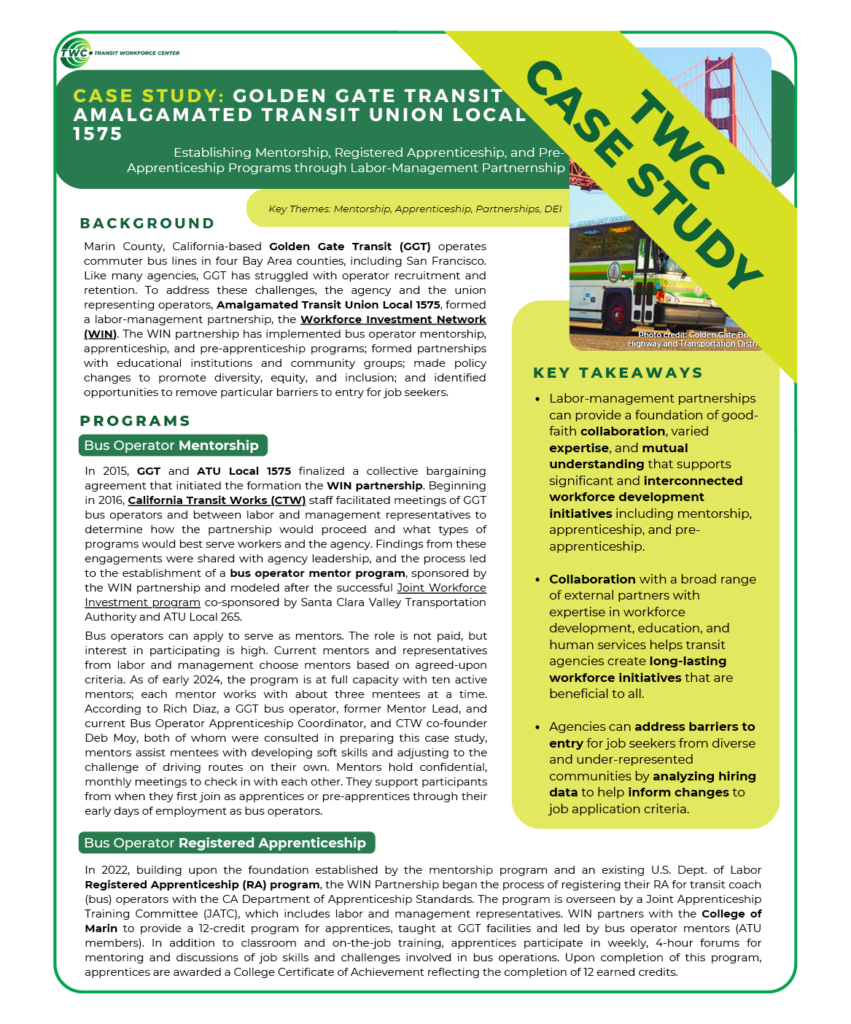
Several transit agencies across the country have established Second Chance programs to support formerly-incarcerated individuals as they reenter the workforce; these programs set pathways into frontline transit positions, often focusing on driver recruitment. These initiatives involve active collaboration between transit agencies and departments of corrections. Agencies have also worked with other partners, including their local unions, state and local workforce development agencies, ex-offender support programs, and local community organizations.
TransitCenter’s report, entitled Bus Operators in Crisis: The Steady Deterioration of One of Transit’s Most Essential Jobs, and How Agencies Can Turn Things Around, analyzes the nationwide phenomenon of bus operator shortages and advocates for enhanced job quality in the occupation.
National Transit Frontline Worker Recruitment Campaign
Across the United States, whether large, small, urban, rural, or tribal, transit agencies are facing the challenge of recruiting and retaining drivers, mechanics, and technicians who can operate and maintain the buses of our public transit systems. To help support local transit efforts, TWC is developing the #ConnectingMyCommunity national frontline worker recruitment campaign, coordinated with the Federal Transit Administration (FTA) and industry, labor, and community partners from around the country.
Transit Manager’s Toolkit: Driver Recruitment, Training, and Retention
This toolkit from National RTAP introduces both requirements and suggested practices in driver recruiting/hiring, retention/motivation, and training. It includes information about federal requirements, how to create a positive work environment, and training standards.
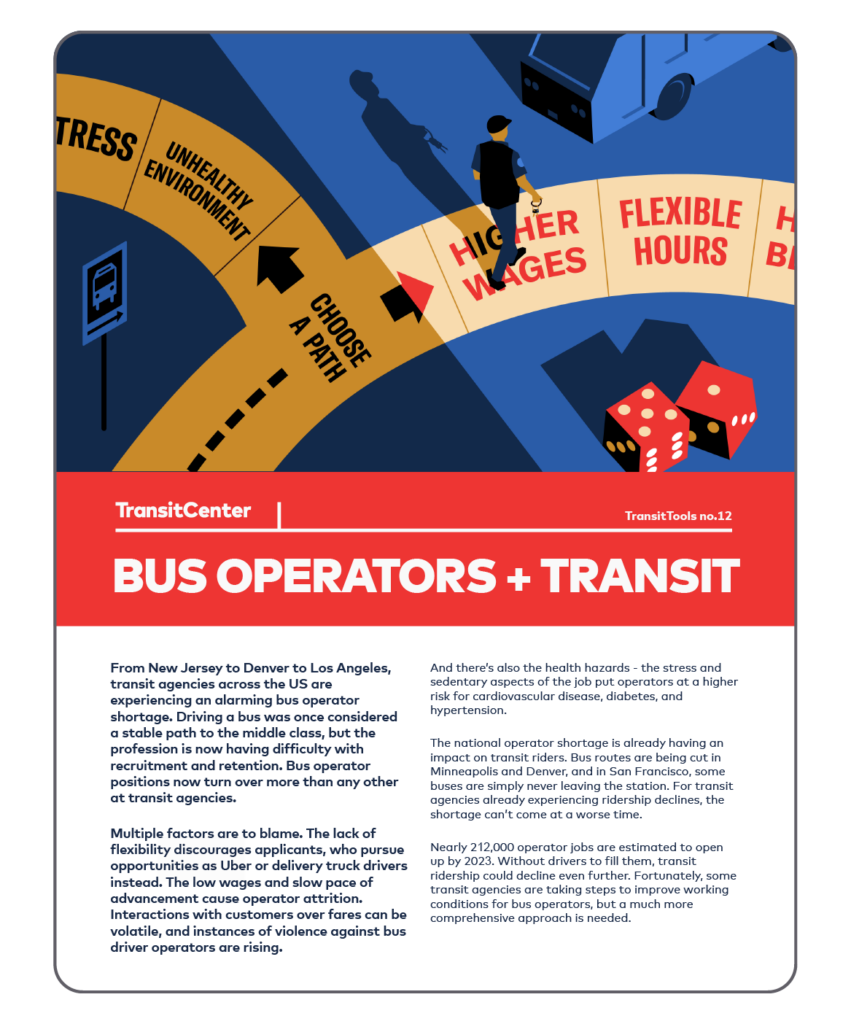
While the U.S. public transportation industry has long had a significant bus operator shortage, it has been magnified by the COVID-19 pandemic. COVID-19 has not only exacerbated existing trends, but also introduced new labor market dynamics. This brief describes overall workforce trends for bus operators, obstacles to recruitment, and challenges for workforce retention, to help inform efforts to recruit more drivers nationwide.
Overall workforce trends
According to 2020 Bureau of Labor Statistics (BLS) data, there are 162,850 bus operators nationally. Federal government projections indicate strong growth for bus operators; BLS estimates the occupation will grow “much faster than average (15 percent or higher).”[1] To keep up with growth and make up for retirements and turnover, the industry will need to recruit scores of new workers. BLS reported an annual average of 24,600 projected bus operator job openings for 2020 to 2030.[2]
According to BLS, annual wages for the occupation were $45,900 in 2020, which was higher than the national median of $41,950.[3] Despite having a reputation for paying relatively well and providing robust benefits,[4], [5] transit agencies have faced significant challenges to recruit workers in sufficient numbers to meet the growing demand. The rise of COVID and the omicron variant have created a “labor crisis” in transit, leading Houston Metro to offer bonuses of $4,000 for new drivers, and NYC to try to lure workers out of retirement, for example.[6]
Demographic challenges
One major demographic challenge contributing to the current operator shortage is the disproportionately older bus operator workforce. As Figure 1 on the next page shows, the median age of U.S. workers was 42.2 years in 2021, and 42.8 years in transportation and warehousing. For the bus service and urban transit industry, it was 52.7, which is substantially higher than both the nationwide median age for workers and the median age for other subsectors within transportation and warehousing, such as air or rail transportation.[7] The higher median age of urban transit workers is largely attributable to the older age of bus drivers (median 53.3 years)[8], who constitute 60 percent of the workforce[9]. A large percentage of workers are expected to retire in the coming years.[10], [11]
COVID-related health and safety issues
Figure 1. 2021 Median Age of Workers for Selected Transportation Sectors
As frontline workers, bus operators risk exposure to COVID-19, and serious health consequences, even death. For example, in New York City, 136 MTA operators died around the start of the pandemic.[12] As of December 2021, more than 2,000 COVID cases have been reported among WMATA workers since the pandemic began; seven of the workers died. According to CTAA, some member agencies have experienced as many as 40 percent of their operators absent from work due to sickness.[13] COVID-related factors have resulted in bus operator shortages and service cuts,[14] a trend which has occurred in transit systems nationwide. In addition, some drivers have quit due to fears about the virus or been terminated due to failure to comply with vaccination and testing policies.[15]
Pre-existing labor market dynamics
The pandemic has also exacerbated existing workforce challenges, such as competition for pay. Stakeholders interviewed for a GAO study reported that other industries which hire workers with similar levels of education, including fast food, may attract workers instead of transit, especially in rural areas or areas with low unemployment.[16] When the economy is strong, construction also tends to attract workers who might otherwise work in transit. Furthermore, some workers leave the transit industry once they have earned their CDL.[17]
CDL and new requirements
Transit bus drivers are generally required to hold Class B Commercial Drivers’ Licenses and passenger (P) endorsements. Due to the high cost of self-funding CDL training, employer-sponsored training programs in which costs are covered, such as those run by transit agencies, are an attractive option for job seekers. However, the potential exists for trainees to pursue employment in commercial driving or another sector after completing a transit-oriented training program.[18] This dynamic is particularly challenging given concurrent shortages of truck and school bus drivers.[19]
Individuals are required to hold a standard driver’s license to qualify for a commercial learners’ permit, which in turn is needed to pursue CDL training.[20] These requirements may impact recruitment of young people, as rates of driver’s license attainment for 18–24 year-olds have decreased slightly in recent decades and may be lower during recessionary periods and among residents of cities.[21]
Regulatory changes impacting entry level driver training (ELDT) may also affect agencies’ ability to fill positions. As of February 7, 2022, the FMCSA has started enforcing universal training standards for entry level driver training and maintaining a database of qualified providers (the Training Provider Registry).[22] Professional organizations representing transit agencies such as APTA and CTAA have expressed concern about these additional regulatory requirements. Agency contacts have also identified challenges related to requirements around license renewal, medical fitness testing, the availability of training during the pandemic and delays with local DMVs processing CDL application due to pandemic staff shortages. FMCSA has granted waivers around certain other CDL requirements during the pandemic, and recently announced a grant to support state capacity for CDL licensing, though the emphasis appears to be on commercial trucking. [23], [24]
Assaults against drivers
Driver safety has been a persistent problem. Assaults against drivers and altercations with passengers have been well-publicized in communities that transit serves.[25], [26]A 2015 Monthly Labor Review article identified violence as a key challenge facing drivers, with examples including a 2012 attack with rocks in Washington, DC and a 2013 shooting in Seattle.[27] More recently, drivers have reported increased stress during the pandemic and face threats including violence related to passenger non-compliance with mask mandates, among other issues. Such incidents have deterred potential applicants from considering a transit driving career and contributed to early retirements.[28]
Lack of interest from younger generations
Younger workers have different expectations about the workplace, which has made it challenging for agencies to recruit them. Younger workers tend to value flexible schedules, yet operators must often work on holidays and weekends, especially when they first start in the field. New hires in general may not find this attractive.[29]
Advances in technology
Advances in technology present challenges to recruitment and retention. The rise of automation and apps requires drivers to possess technical knowledge to operate newer buses and assist customers; this means there is a relatively small pool of qualified workers. Additional and new types of training are needed for both incumbent and new workers to adapt. Furthermore, drivers report feeling stress from being monitored more often by cameras and tracking technology.[30], [31]
Stress and burn-out
Finally, being a bus operator is a highly stressful occupation. Drivers must operate large vehicles on congested city streets on tight time schedules.[32] They work relatively long hours with infrequent breaks.[33] As discussed earlier, technological advances have contributed to worker stress as well. Operators also experience burn-out due to the stress of dealing with passengers, who may ignore COVID safety rules,[34] or be unruly or violent.
Conclusion
Bus operators have been in short supply for years, and this problem has been magnified by COVID-19. An aging workforce and labor exits related to COVID have largely contributed to the shortage. Top obstacles to recruitment and retention include pandemic-related health and safety issues, pre-existing labor market dynamics including competition over pay, CDL requirements, assaults against drivers, and lack of interest from younger generations. Other contributing factors include advances in technology, perceptions of inflexibility, and stress. To address these workforce recruitment and retention issues for bus operators, key stakeholders from management and labor should keep these data and trends in mind.
The Transit Workforce Center (TWC) offers the following resources under this initiative: the Recruitment Toolkit, a transit agency-focused collection of digital and print materials for their recruitment efforts; Transit Career Explorer, information about the public transportation industry for those considering new careers; and Transit Career Stories, a series of interviews with transit workers on their career journeys.
Contributing Authors: Benjamin Kreider (Consultant); Xinge Wang; Douglas Nevins
[11] Robert Puentes et al. “Practitioner’s Guide to Bus Operator Workforce Management.” Transportation Research Board of The National Academies of Sciences, Engineering, and Medicine. November, 2021. Unpublished interim report.
[16] US Government Accountability Office. “Transit Workforce Development – Improved Strategic Planning Practices Could Enhance FTA Efforts.” GAO-19-2090. March 2019. https://www.gao.gov/assets/700/697562.pdf. P. 15.
Statewide Bus Operator Attraction, Hiring, & Retention Research
These slides were used in a presentation outlining research conducted to better understand the shape and scale of the bus operator shortage in Massachusetts public transit and the adjustments agencies are making to confront these challenges.
The Federal Motor Carrier Safety Administration (FMCSA) established Entry Level Driver Training (ELDT) regulations that set baseline training requirements for entry-level drivers. This rule impacts any individual wishing to obtain for the first time (or to upgrade to) a Class A or Class B Commercial Driver’s License. These resources from the Minnesota Rural Transit Assistance Program (RTAP) provide information about the regulations, training materials, training providers, checklists, etc. to assist transit agencies in complying with regulations.