
Resource Center
The Transit Workforce Center is pleased to host a curated collection of publications and other materials to assist stakeholders engaged in transit workforce development. The Resource Center includes case studies, training materials, research reports, and other materials of interest, including publications produced by federal government agencies, transit organizations, and independent research entities. Resources may be filtered by topic, resource type, and transit mode. This TWC blog post explains how to use the Resource Center.
We are continuing to update the Resource Center regularly. Please contact us via the Request Help menu option if you would like assistance using the Resource Center or are looking for resources on a particular topic. We also welcome suggestions of topics or specific resources to add.
Content in external resources linked from the Resource Center is solely the responsibility of the resource authors and does not necessarily reflect the perspectives of or endorsement by the Transit Workforce Center.
National Apprenticeship Resource Hub
Apprenticeship Programs can help employers develop their future workforce and meet their business needs. The National Apprenticeship Resource Hub includes National Occupational Frameworks which can help develop a new apprenticeship program or refine an existing program. Each framework outlines the basic information sponsors need to register an apprenticeship program in their occupation.
The Urban Institute
December 2024
LEARN MORE
The National Apprenticeship Resource Hub includes Occupational Frameworks which can help develop a new apprenticeship program or refine an existing program. Each framework outlines the basic information sponsors need to register an apprenticeship program in their occupation including an occupational overview that describes the occupation, alternative job titles, and any prerequisites; a work process schedule that outlines what organizations can expect apprentices to learn on the job and the required hours; and a related technical instruction outline that presents considerations for courses and training apprentices can pursue during the apprenticeship. The National Occupational Frameworks also include detailed instructions on how to use them when creating your registration application.
Making Connections 2024 – Train-the-Trainer Bootcamp: Strategies for Successful Instruction
This full-day intensive session about tools for new and experienced trainers to increase retention and engagement was presented as part of TWC’s Making Connections 2024 transit workforce conference in November, 2024.
Transit Workforce Center
November 2024
TOPICS: Making Connections Conference, Policy and Planning, Retention, Trainer and Mentor Development, Training
Session Description: This intensive full-day session, an abbreviated version of TWC’s popular 5-day Train-the-Trainer Level 1 course, provided both new and experienced trainers with new tools to increase engagement, application, and retention. Participants added to their knowledge, skills, and confidence to fully engage learners and effectively facilitate a variety of instructor-led training programs. Topics included adult learning theory, teaching techniques, and instructional elements that really work! Participants also had the opportunity to observe and critique a teaching demonstration — learning what does and what does not contribute to impactful learning.
Check out experienced instructors and your trainer-peers from across the industry to explore the following topics:
- How do adults learn, and what does adult learning theory tell us that we can use in our training?
- What are the key instructional elements of successful classroom and hands-on training?
- What are lesson plans, and how are they developed?
- Which teaching techniques help strengthen classes and instructional presentations?
Speakers:
- Frank Burnett: Training Specialist – International Transportation Learning Center / Transit Workforce Center
- Julie Deibel-Pundt: Program Director, Instructional Design – International Transportation Learning Center / Transit Workforce Center
- Marina Budeyeva: Instructional Designer – International Transportation Learning Center / Transit Workforce Center
- Jessica Supervielle: Instructional Designer – International Transportation Learning Center / Transit Workforce Center
Making Connections 2024 – Identifying Training Needs, Assessing Workforce Skills Gaps, and Creating Strong Training Programs
This session about assessing training needs and workforce skills gaps was presented as part of TWC’s Making Connections 2024 transit workforce conference in November, 2024.
Transit Workforce Center
November 2024
LEARN MORE
Session Description: Participants explored effective methods for identifying training needs and assessing workforce skills gaps to develop robust training programs, all in the context of ensuring worker voice and involvement. The session covered tools and techniques for evaluating current training needs for frontline workers, identified areas for improvement, and aligned training strategies with organizational goals. Attendees learned how to use data-driven approaches to map out training priorities that address immediate operational needs and long-term workforce development.
Moderators:
- Kristen Ribaudo: Senior Instructional Designer – International Transportation Learning Center / Transit Workforce Center
- Stu Bass: Principal – Progress Worx; Founding Director – Keystone Development Partnership
Speakers:
- Jeffrey Di Perna: Financial Secretary/Treasurer – Amalgamated Transit Union Local 85 (PA)
- Jason Macumber: Senior Advisor of Workforce Development and Technology – International Transportation Learning Center / Transit Workforce Center
Making Connections 2024 – Engaging and Interactive Training Strategies
This session about innovative and engaging training methods was presented as part of TWC’s Making Connections 2024 transit workforce conference in November, 2024.
Transit Workforce Center
November 2024
LEARN MORE
Session Description: This session was designed to enhance learner engagement by utilizing interactive learning techniques. Through a discussion led by a panel of seasoned instructional designers from varied backgrounds, the workshop demonstrated how to translate material into engaging activities through the use of storytelling, gamification, and real-world problem-solving exercises. Additionally, the workshop showcased a blend of traditional methods and innovative technology tools to create learner-centered instructional experiences that promote critical thinking, problem-solving, and collaboration through group work and discussions.
Speakers:
- Julie Deibel-Pundt: Program Director, Instructional Design – International Transportation Learning Center / Transit Workforce Center
- Frank Burnett: Training Specialist – International Transportation Learning Center / Transit Workforce Center
- Allie Franklyn: Instructional Designer – International Transportation Learning Center / Transit Workforce Center
- Kristen Ribaudo: Senior Instructional Designer – International Transportation Learning Center / Transit Workforce Center
Case Study: Mentoring in the Paratransit Setting
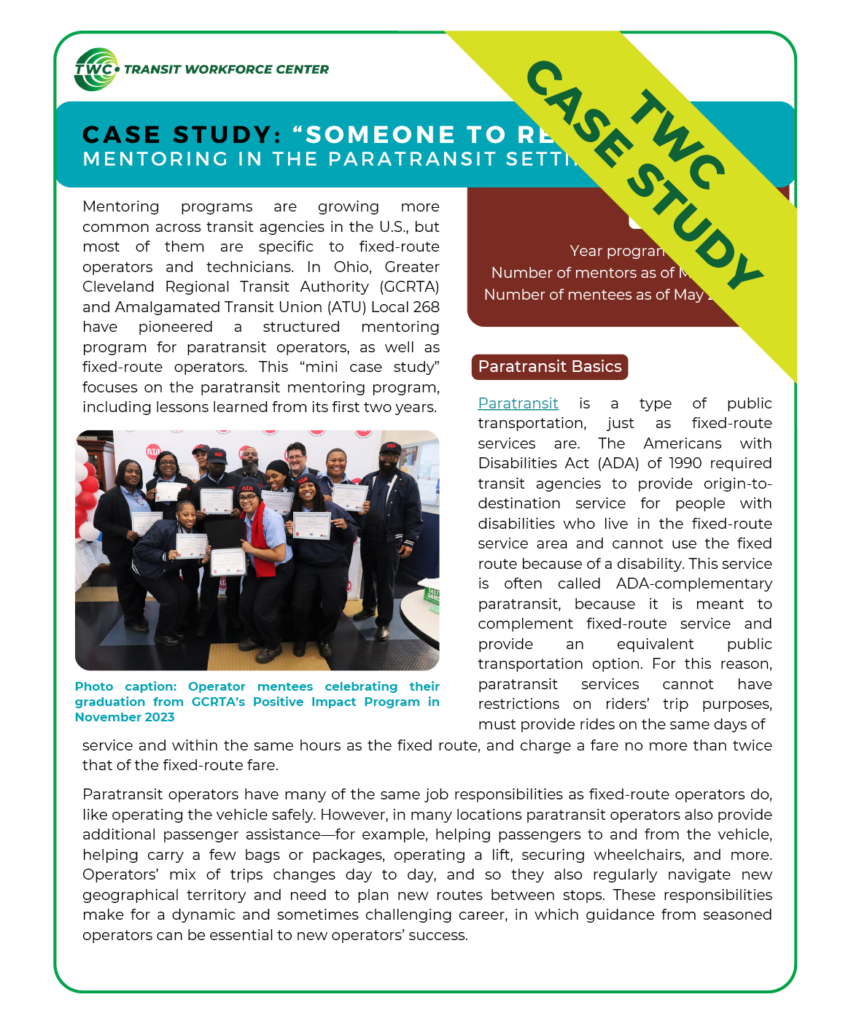
In Ohio, Greater Cleveland Regional Transit Authority (GCRTA) and Amalgamated Transit Union (ATU) Local 268 have pioneered a structured mentoring program for paratransit operators. This “mini case study” focuses on their lessons learned from its first two years.
Transit Workforce Center
September 2024
LEARN MORE
“Someone to Rely On”
Mentoring programs are growing more common across transit agencies in the U.S., but most of them are specific to fixed-route operators and technicians. In Ohio, Greater Cleveland Regional Transit Authority (GCRTA) and Amalgamated Transit Union (ATU) Local 268 have pioneered a structured mentoring program for paratransit operators, as well as fixed-route operators. This “mini case study” focuses on the paratransit mentoring program, including lessons learned from its first two years.
Mini Case Studies: Low-No Workforce Transition
In the past decade, the number of hybrid, battery-electric, and hydrogen fuel cell buses has increased substantially across the U.S., particularly as transit locations have made use of FTA’s Low-No grant program. Well-developed and proactive training and preparation of technicians and operators is critical for a successful transition to new vehicle technologies; maintaining and operating newly procured vehicles effectively is necessary for fleet reliability and efficiency. Transit locations have supported training and other initiatives through FTA’s Low-No grants, which offer 5% for workforce development, as well as through formula funds. These mini case studies offer examples of training, retention, and procurement methods being used by transit agencies to support new fleet technologies.
Transit Workforce Center
August 2024
LEARN MORE
In the past decade, the number of hybrid, battery-electric, and hydrogen fuel cell buses has increased substantially across the U.S., particularly as transit locations have made use of FTA’s Low-No grant program. Well-developed and proactive training and preparation of technicians and operators is critical for a successful transition to new vehicle technologies; maintaining and operating newly procured vehicles effectively is necessary for fleet reliability and efficiency. Transit locations have supported training and other initiatives through FTA’s Low-No grants, which offer 5% for workforce development, as well as through formula funds. These mini case studies offer examples of training, retention, and procurement methods being used by transit agencies to support new fleet technologies.
- Foundational Skills and Technician Engagement at Champaign-Urbana Mass Transit District
- Bringing Training In-House at Mountain Line and Teamsters Local 2
- Transferable Knowledge and Train-the-Trainer at IndyGo and ATU Local 1070
- Innovative Technology and Documentation for Workforce Transitioning at AC Transit and ATU Local 192
- Training Operators Through Pre-Apprenticeship, Apprenticeship, and Mentorship at Golden Gate Transit and ATU Local 1575
- Frontline Worker Involvement in Vehicle Procurement at SporTran and ATU Local 588
- Midwest Hydrogen Center of Excellence at SARTA and AFSCME Local 1880
Youth Apprenticeship Access and Success in Rural Communities
In rural communities, widely dispersed populations face a multitude of access challenges. Faced with a declining talent pool, lower educational attainment, and rising poverty rates caused by the Covid-19 pandemic, there is an urgent need to prepare young people in rural areas for high-demand careers.
WorkforceGPS
August 2024
TOPICS: Apprenticeship, Career Pathways, Community Engagement, Mentorship, Retention, Trainer and Mentor Development
In rural communities, widely dispersed populations face a multitude of access challenges. Faced with a declining talent pool, lower educational attainment, and rising poverty rates caused by the Covid-19 pandemic, there is an urgent need to prepare young people in rural areas for high-demand careers.
As part of the Implementing Workforce Programs for Rural Youth series, this webinar, hosted by the Office of Apprenticeship, focused on best practices and creative solutions for increasing pre-apprenticeship and youth apprenticeship access, enrollment, retention, and program completion for young people in rural areas. Featured youth apprenticeship intermediaries and partners shared their accomplishments in developing youth apprenticeship opportunities in rural areas, establishing networks of support, and best utilizing available resources to ensure pre-and youth apprenticeship success.
MODERATOR(S)
- Maisha Meminger, Manpower Analyst , Division of Youth Services, U.S. Department of Labor, Employment and Training Administration
PRESENTER(S)
- Vanessa Bennett, Associate Director, Center for Apprenticeship & Work-Based Learning, Jobs for the Future
- Zach Boren Senior Policy Program Manager, Urban Institute
- Bhavani Arabandi, Senior Research Associate, Urban Institute
- Jacqueline Rayfield, Policy Analyst, Urban Institute
Case Management and Coaching for Pre-Apprentices and Apprentices
Working with pre-apprentices and apprentices requires a combination of case management and coaching. This webinar provides the fundamentals of case management and coaching and teaches a framework for effective service delivery. This session also focuses on the use of assessments for productive service planning, quality program documentation and team communication for successful handoffs.
Workforce GPS
August 2024
LEARN MORE
Working with pre-apprentices and apprentices requires a combination of case management and coaching. This webinar provides the fundamentals of case management and coaching and teaches a framework for effective service delivery. This session also focuses on the use of assessments for productive service planning, quality program documentation and team communication for successful handoffs.
MODERATOR(S)
- Luis Roig, Contracting Officer’s Representative, Office of Apprenticeship, U.S. Department of Labor Employment and Training Administration
PRESENTER(S)
- Amy Landesman, Grantee Coach, ICF
- Valerie Taylor, Grantee Coach, ICF