




 1-855-888-NTWC (6892)
 twc@transportcenter.org
Findings from Surveys and Interviews
Background
At many transit agencies across the United States, bus operator hiring processes remain lengthy, causing candidates to abandon their candidacy in favor of other jobs and exacerbating transit operator shortages. Even in locations where the number of applicants has risen since the dwindling of the COVID-19 pandemic, long hiring processes hurt transit agency reputations and risk the agency losing its best applicants, who may secure other employment options rather than wait months to hear back on an operator position. Building an efficient process even in times of relative abundance of candidates ensures the agency is ready for periods when applications are scarcer and candidates must be moved through the process quickly.
This brief presents key findings on the state of the practice from our survey of 84 individuals involved in bus operator hiring across 74 transit agencies in 29 states and territories, as well as in-depth interviews with 15 transit agencies about their operator hiring processes. Other findings from review of secondary sources, like existing literature and Glassdoor reviews, are available in a separate literature review brief.
Only 45 of the 84 respondents came from agencies that were full reporters to the National Transit Database (NTD) of directly operated services; because only such agencies report employment data to NTD, we are only able to report on the number of bus operators at these 45 agencies. Extracting the number of operators in NTD’s vehicle operations job function for five bus modes (bus, bus rapid transit, commuter bus, demand response, and trolley bus), we found that the number of bus operators at respondents’ agencies ranged from 39 to more than 3,000. One third of survey respondents’ agencies had fewer than 200 bus operators. Non-reporter respondents likely have comparatively lower numbers of operators.
Number of Bus Operators by Survey Respondent
In inviting agencies to participate in the study, we sought to mirror this variation of agency size; interviewees’ number of bus operators had a similar range to that of survey respondents.
Major Challenges in Operator Hiring Processes
The four most commonly reported hiring bottlenecks were:
- Time between completion of pre-employment steps and start of paid training/onboarding (35% of survey respondents)
- Physical/medical examination (31% of survey respondents)
- Drug/alcohol testing (27% of survey respondents)
- Criminal background check (27% of survey respondents)
In research interviews, agency staff reported that issues frequently came up on the medical examination that could stall the process. In particular, medical holds due to potential sleep apnea were common; these can require a sleep study, the cost of which would have to be absorbed by the jobseeker if their insurance declined to cover it.
Background checks, for some agencies, were also a potential complication. Agencies that have review criminal background issues on a case-by-case basis are sometimes able to hire otherwise qualified candidates, and in general this type of individual background review can be a best practice, but such reviews can become lengthy if insufficient staff time is devoted to them. While all agencies must make several good-faith attempts to collect information on failed or declined drug tests from a candidate’s prior employers that were covered by U.S. Department of Transportation regulations, at least one agency had a policy requiring them to hear back from prior employers before proceeding with hiring. Prior employers do not always respond promptly and this policy has proved a significant challenge.
Finally, the process of obtaining a commercial driving permit—and ultimately a commercial driver’s license (CDL)—along with passenger endorsements has been a hurdle for some candidates and their prospective employers. To ameliorate this issue, about half of survey respondents reported that their agency provides some form of financial support for the CDL process, whether through paid training, paid study time, and/or financial assistance with the cost of the test or permit.
Recruitment and Outreach Strategies
A strong hiring process begins with a robust recruitment pipeline. The mostly commonly cited recruitment techniques mentioned in research interviews were (in order of frequency mentioned):
Employee referral/word-of-mouth
Community partners like local colleges, non-profits and community-based organizations, CDL schools, re-entry groups, unemployment offices, and libraries
Posting on relevant websites (e.g., Indeed, LinkedIn, Glassdoor, and Craigslist)
Social media
Local news
Physical ads on transit buses; billboards
Despite most agencies using a wide variety of recruitment methods, only one reported engaging in a concerted effort to track which recruitment channels yielded the most—and best—candidates.
Minimum Qualifications
The minimum requirements for bus operators ranged from no experience required beyond a standard driver’s license to extensive lists of prerequisites. Common job requirements for bus operators included:
- A high school diploma or General Education Development (GED) equivalent
- Minimum age—often 21 years or older, sometimes 18 or 19
- Commercial Learner’s Permit or Commercial Driver’s License, in some cases with passenger endorsement and without air brakes restriction
- Minimum number of years of experience with a driver’s license for standard non-commercial vehicles; minimums ranged from six months to seven years
- Work experience (sometimes required, sometimes merely preferred) operating passenger and/or commercial vehicles, providing customer service, or working with older adults/persons with disabilities. Some agencies specified the number of years of experience required.
- U.S. citizenship or work authorization
- English proficiency
- Familiarity with state traffic laws
- Ability to pass physical examination, drug/alcohol test, criminal background check (with whatever background check parameters the agency adheres to)
- Specific thresholds for vision and hearing
- Steady work history or minimum years of work experience (e.g., three years working in the last five years) or minimum durations (e.g., at a single employer for at least one full year)
- Excellent driving record; some agencies set specific parameters (e.g., no suspensions or revocations within the last five years, no moving violations within the last three years)
- Skills with technology, preparing reports, following instructions, communication, map-reading, time-telling; ability to lift 50 lbs; availability for shifts at non-standard hours; ability to sit for long periods without discomfort, bend and squat, reach, assist passengers on and off the vehicle, etc.; reliable transportation; positive attitude; ability to work with minimal supervision
Average Timelines
In our survey results, the mean number of days that elapse between the time a bus operator candidate submits their application and their employment start date was 51. This average signals that the transit industry likely takes longer to hire candidates on average than other industries do. The average hiring process across industries takes three to six weeks; if our survey’s average falls near the true mean for the transit industry, transit would be well outside the upper limit of that range (more than seven weeks).
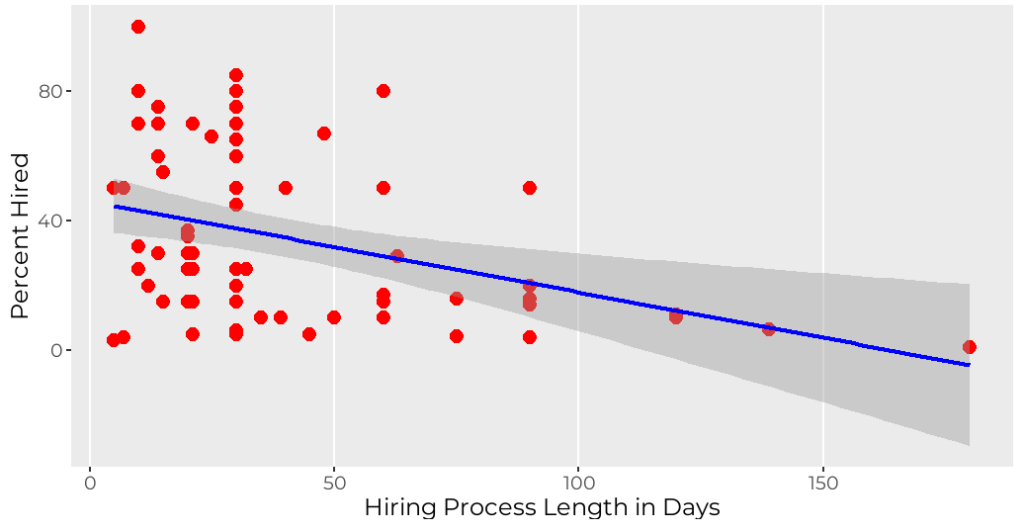
The number of days the process took appeared to be negatively associated with the percentage of applicants ultimately hired among agencies we surveyed, as shown in the chart below.
Percent of Applicants Hired by Number of Days the Process Takes
We also asked respondents to indicate the number of days each step in the process typically takes. The results are shown in the table below.
| Step | Average Length in Days* |
|---|---|
| Time between completion of pre-employment steps and start of paid training/onboarding | 17.26 |
| Time between application submission and applicant being first contacted back (i.e., screening/application review) | 14.65 |
| Dept. of Transportation physical/medical examination (including time to schedule it and wait for it to occur) | 11.52 |
| Criminal background check | 9.12 |
| Job interview process (including scheduling the interviews(s), waiting for them to occur, etc.) | 8.92 |
| Drug/alcohol testing | 7.01 |
| Checking candidate references | 6.67 |
| Assessments or tests (including scheduling the tests and waiting for them to occur) | 6.21 |
| Review of driving record/licensure | 5.09 |
Given the averages, it is unsurprising that respondents named the criminal background check, medical examination, and time waiting for a training start date among their greatest bottlenecks, as each of these takes longer than nine days on average.
Most respondents (nearly 80%) reported communicating to bus operator candidates at least general expectations for how long the hiring process may take.
Withdrawals and Disqualifications
Common Reasons for Candidate Disqualification
Of the 84 survey respondents, 51% it was common for applicants to be disqualified from the hiring process due to a failure of the drug/alcohol preemployment test. Forty-six percent said it was common for applicants to fail the criminal background check, while 44% said it was common for applicants not to be advanced due to poor fit, references, job interview performance, etc. A small portion of the respondents (11%) said that failure of an aptitude test was a common reason for bus operator candidate disqualification. Other reasons cited in write-in responses included concerns on their driving record, failure to obtain a CDL permit, and issues passing the physical examination.
Common Reasons for Applicant Withdrawal
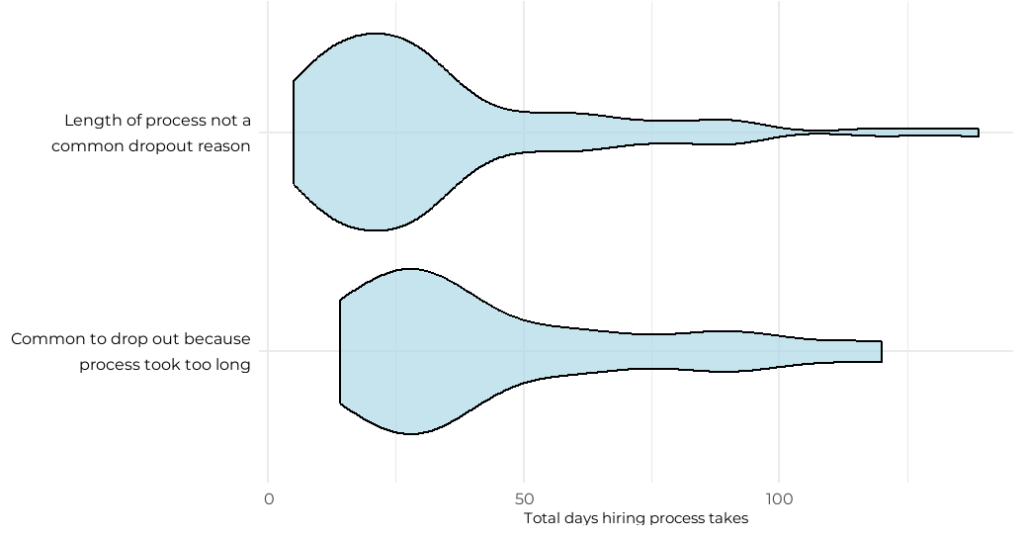
When asked about common reasons that applicants voluntarily withdraw or drop out of the hiring process, 48% said finding a job with better pay, benefits, or schedules was common, while 52% said that it was common for applicants to decide, upon learning more about the job, that it was not a good fit. Only 23% reported that the process taking too long was a common reason for applicants dropping out of the process. However, the violin plot below indicates that hiring-process length may remain a problem for transit agencies. The chart shows the distribution of total number of days the hiring process takes between those who reported that process length caused candidates to commonly drop out versus those who did not (outliers above 150 days were removed in this chart [3 cases]). The relative width of each part of the graphic indicates the number of respondents reporting their agencies’ operator hiring process lasts the number of days indicated on the corresponding part of the X axis. Overall, those reporting their hiring process length was an issue for candidates tended to have longer hiring processes.
Whether Process Length an Issue by Total Days
Onboarding and Frequency of Training Classes
A little less than 20% of respondents reported only hiring on certain cycles or at certain times, and thus only holding training classes when a cohort of new hires is ready to begin. The remainder of respondents reported hiring fairly continuously, with about half of the continuous-hiring group reporting that training classes are nonetheless only held at certain times and applicants thus end up often waiting weeks to start training (i.e., they only start employment when the training classes are ready to be delivered).
The frequency and duration of training classes varied widely. Bus operator training lasted anywhere from 1 to 13 weeks among agencies interviewed for this research. The frequency of training class start dates ranged from weekly, or right away upon hire, to about bimonthly. For most agencies interviewed, onboarding comprised a single day, or half day, of paperwork and basic orientation before training.
Uses of Technologies, Consultants, and Other Resources
The main technologies agencies reported using in the hiring process were applicant tracking systems and human capital management platforms, electronic appointment booking platforms, and electronic signature management services. Agencies did not commonly report using artificial intelligence as part of their hiring processes, and only a few used consultants or other external resources to improve the process. For several agencies, a key obstacle to accelerating the hiring process was a lack of integration between technological platforms, requiring manual data entry to get information from one system to another.
Additional Resources
This brief presented a summary of key high-level findings from our research on transit bus operator hiring processes. Additional resources developed as part of this project provide more detailed tips and best practices for agencies on each step of the process.
Contributing authors: Shayna Gleason
This page is part of TWC’s Streamlining Operator Hiring Practices research initiative aimed at documenting current transit agency hiring processes for operators and producing new resources to support agencies’ operator hiring efforts. Through background research, an industry survey, and interviews with 15 transit locations, the TWC research team has produced a series of fact sheets, briefs, and other resources focused on various aspects of the hiring process. Check out the initiative landing page to learn more about the project and to see the other resources.
